In 1858 Robert William Morgan, my first cousin four times removed, decided to pick a fight
with a Captain Alsop in the Queen’s Arms public house on the road between Totnes and
Dartington …
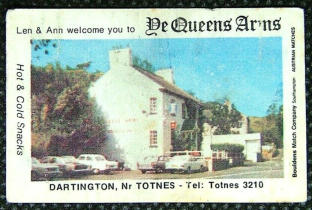
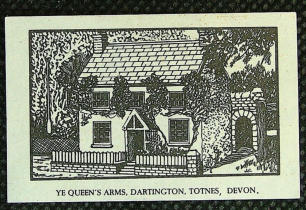
The Queen’s Arms, Puddaven
illustrations from matchboxes
The Queen’s Arms public house is said in some sources to have been built in 1790 as a wool store.
However that may be it was operating as an inn from at least 1836 when it was taken over by George
Please as tenant. When the property came to be sold in 1853 he is said to have “carried on an extensive
and lucrative business” in the substantial stone-built premises for 17 years.
The Premises consist of a commodious bar, kitchen, two parlours, four rooms over, two of which
communicate with each other by folding doors, forming a room 30ft. by 14 ft., convenient for club and
parish meetings and other public business, with two roomy attics; also beer and cider cellars, dairy, coal-
hole, kayle-alley, piggery, pump-house, wash-house, and every convenience; together with a detached
brewhouse, stabel, cow-houses, cart linhay, and courtlage, front and kitchen gardens. […] The above
property is situate on the turnpike-road (which is a great thoroughfare) between Ashburton and Totnes,
via the Railway Station, about a mile from the latter place, and is a favorite resort of gentlemen visiting
the River Dart on fishing excursions. Western Times 9 April 1853
George Please moved into Totnes to run a grocers on Fore Street and it would appear that William
Whiteway didn’t just become the new tenant at about this time, but actually bought the property. Born
in 1813 he is living with his parents in nearby Week in 1841 and working, like his father a s a
shoemaker. In 1851, still in Week and now with a wife Mary and four children, he is an Innkeeper and
shoemaker. Under his management, during the 1850s the Queen’s Arms hosted wrestling matches, the
annual salmon dinners, and New Year balls. In the great frost of 1855, when the Dead River above
Totnes Weir was frozen over and had become a “grand skating ground […] The ice-field being far from
refreshment houses, Mr. Whiteway, of the Queen’s Arms, was induced to erect a tent on the ice, and
was rewarded by taking the goodly sum of £10 for his energy. Hot roasted potatoes and chestnuts were
also very acceptable”. Totnes Weekly Times 23 February 1895. Reminiscences of Great Frosts - 1855 - year of
the Crimean War.
He is still running what the census calls the Queen’s Arms Hotel in 1861, and after his death in 1864, his
wife continued to run the business with her unmarried daughter Amelia, until her death on the 25th
June 1900. Amelia is still running the pub in 1911 and appears on the voters’ list there until her death
on the 4th August 1922 at the age of 81. The Queen’s Arms - “the only public house between Totnes
and Ashburton, and Totnes and South Brent” - was sold by public auction in October 1922; it was
bought by Mr. F. C. Felderman of Paignton for £1080 and “£41 for trade fixtures”. The establishment
continued as a pub until 2008, and is now a private residence.
The Queen’s Arms possibly took its name from the land it faced across the road and the Bidwell Brook:
now known variously as Queen’s Marsh and Queen’s Meadow, this area, until the building of the weir
on the Dart just above Totnes in 1584, had been a tidal creek. According to Eric Hemery in his book
Historic Dart, “one rather special boat on this creek, according to oral tradition, carried Queen Elizabeth
I to Dartington to be entertained at the Hall by Sir Arthur Champernowne (this before the building of
the first Totnes Weir). The plain between river and drive is to this day called Queen's Meadow”.
Alternatively, as the pub was running in the late 1830s it could have been a nod towards the new
Queen Victoria.
Or was the marsh/meadow named for the pub? During the consultation process for the building of the
South Devon Railway in 1861 the area is known officially as Buckham’s Marsh, and the 1887 ordnance
survey map shows Buckham’s Park Copse directly to the north of the marsh. It is referred to as
Buckham’s Marsh when recounting the ice-skating exploits of certain clergy in the 1830s:
[...] ice carnivals, especially that of Christmas, 1830-31, when some fine collegian skaters (the Ven.
Archdeacon Froude, his sons William and Anthony, Rev. William Martin and others) showed some rare
exploits, Mr. Martin leaping over a high chair, in his skates, on the ice field then in Buckham's Marsh”.
Totnes Weekly Times 23 February 1895
In 1808, in Vancouver’s General View of the Agriculture of the County of Devon, the former tidal estuary is
referred to as Buckham’s Marsh. In fact the earliest reference I have found to it being called the
Queen’s Marsh or Meadow is in the Hemery book published in 1982 where the name is used to back up
the oral tradition of Queen Elizabeth’s visit! I don’t have access to the Dartington Estate archives, and
they may show more than I have managed to find out, but there are current plans to make the area
into a wetland habitat, and they have wholeheartedly opted for the name Queen’s Marsh.
Captain John Alsop
So I decided to do a quick bit of research into Capt. Alsop, the object of Robert
William Morgan's drunken anger at the Queen's Arms in 1858, not expecting to find
much, and ended up looking into Devon's Newfoundland trade, Liverpool shipping
and silk manufacture in Leek in Staffordshire.
Captain Alsop was Robert Morgan's senior by about 10 years, so Robert's taunts
may just have been a case of drunken bravado. It wasn't too difficult to find the
Captain in the 1851 census, as there was only one Alsop of a suitable age and
occupation in the south Devon area. Though actually living in Dartmouth with his
wife Catherine in 1851, he had been born in Newton Abbot, or Newton Bushell
rather, in 1815, and baptised in Wolborough on the 24th November that year. His
parents were Robert Alsop, a merchant, and his wife Carteretta Nichols who had
married in Wolborough in 1813. Carteretta and Robert also had the following sons:
Robert who was baptised in Highweek on the 10th June 1814; Carteret Alsop who
was baptised in Highweek on the 4th November 1817; James Wardle Alsop
baptised in Wolborough on the 10th October 1822 (and buried on the 18th July
1826); and Henry Alsop baptised in Wolborough on the 5th August 1827.
John Alsop's family had settled in Liverpool by 1835 when Robert Alsop (most likely
John's father) made a contribution of £5 towards the building of a new chapel in
Newton Abbot. Exeter Flying Post 8 October 1835. The 1841 census finds them at 35 Salisbury Street,
with Robert senior and Carteret both described as Merchants, and John as a Mariner. John's older
brother Robert was away from home, either at sea or already running the family business - Robert
Alsop & Co. - in St John's, Newfoundland. Carteret and Henry would eventually join him there, while
John remained the mariner of the family, keeping his Devon connections. Both John's parents died in
1844 and were buried in the graveyard of the parish church of St Mary, Edge Hill.
Trading as Robert Alsop & Co. in Liverpool, John's father had originally been in partnership with William
Codner, and John Drew, "carrying on business in St. John's, Newfoundland, on the coast of Labrador,
and at Ringmore, in the County of Devon, England". This partnership was dissolved by mutual consent
on the 3rd of March 1825 according to the London Gazette, and it was probably shortly after this that
Robert with his wife and young family moved their part of the business to Liverpool, as the small fleet
was gradually divided up with Codner & Co keeping the Devon interest. The Alsop's business thrived
through to the 1850s, running a fleet of up to four ships trading from Liverpool and Teignmouth to
Newfoundland and European ports, and also from London to South America. They survived the
destruction of their mercantile house in the fire that ravaged St. John's in 1846, and Carteret (in
Liverpool) and John (in Newton Abbot) both subscribed to the aid fund set up to provide support in the
face of "the utter destitution, and upwards of twelve thousand human beings ... now houseless, and
dependant for daily bread upon the bounty of the few who were more fortunate than themselves." The
fire arising from a spark in a carpenter's shop, driven by a strong wind, and fuelled by the huge vats of
seal and whale oil, had rapidly destroyed the mainly wooden buildings of the town.
So Robert William Morgan was 8 when John Alsop was mate in 1835 on his family's
ship Cartaretta, (or Carteretta) under Captain John Warren, sailing out of Liverpool
for Newfoundland and importing train, or whale, oil, dried cod and capelin. He was
11 when the now Captain John Alsop sailed the newly built company brig Rosalie on
her launch in Dartmouth in 1838 to Portugal; a voyage that ended with the Rosalie
being towed by a steamer back to Dartmouth having lost her foremast and nearly
all her sails in a storm. In 1841 he sailed her out of Liverpool for Copenhagen, and
also took on the route from Liverpool to Rio and Valparaiso, making regular
crossings in the Rosalie between 1839 and 1845, and one final voyage in 1849
bringing back wheat and hides from Valparaiso.
John Alsop had married Catherine Porter Wills in Dartmouth on the 19th March
1845, probably expecting to be able to retire from the sea. His 1849 voyage must
have been a last minute decision, for Lloyd's Register names the Rosalie’s captains
as Boyes from 1845 to 1848 and Cummings from 1849. These are the years now
when his path could have crossed that of Robert William Morgan; the latter might
have been a "big man" according to the bribery accounts, but John Alsop, as a Cape
Horner, can't have been a pushover. However John and his wife had just separated;
the 1861 census finds Catherine living with her widowed sister Caroline in
Dartmouth, while John is a lodger in Widecombe. In 1871 John is in Limehouse in
London and working as an auctioneer's clerk while Catherine is in Hastings. They
divorced in 1872. John is back in Devon in 1881, lodging in Morchard Bishop, near
Crediton; Catherine is living with her widowed sister Harriet in Cricklewood, which
is where she died in November 1886, and according to her death notice in the local
paper she had been living there for 29 years. She is described as the widow of the
late John Alsop, for he had died in January 1886 in West Leigh near Harberton.
John doesn't appear from the censuses to have had much contact with his relations
in Newton Abbot, but someone must have shared the news of his death with the
few family members still in Newfoundland as it was reported on the 24th March in
the Newfoundland Times. All three of his brothers had settled there during the
1850s: Carteret died there in 1864 without apparently marrying, and Henry had
married Louisa Mary Blackman there in 1853; though I'm not sure if this marriage
was a success, as from the details in Boyd's Inhabitants of London, Henry died at
Hilston in New South Wales in 1888, while his wife who died in London in 1894, had
been living in England and Scotland since at least 1871.
The descendants of his brother Robert, however, certainly were still there, and
although the early Canadian records are a bit hit and miss, the family trees on
Ancestry mostly agree that he had two sons and perhaps two daughters, though
there is no agreement on the names of his wives. Robert himself merits an entry in
the Dictionary of Canadian Biography:
He became a principal in the merchant and shipping firm of R. Alsop and Company,
which in the 1840s and 1850s was one of the most extensive trading out of St John’s,
Newfoundland. Like many of the older firms, it suffered severely during the late 1850s
and 1860s because of the failure of the fisheries. After the decline of the firm Robert
Alsop was induced to enter political life.
and from Wikipedia:
Alsop was first elected in a by-election held in 1866. He served in the Executive Council as
chairman of the Board of Works. He was opposed to union with Canada. Alsop was
named colonial secretary in 1870. When he ran for reelection because he had been
named to a cabinet post, he was defeated but then was named to the Legislative
Council, continuing to serve as colonial secretary until his death in St. John's [on the
25th March 1871].
A useful collection of Alsop snippets, showing primarily their business dealings to
and fro across the Atlantic and in St John's from the early 1800s until the dissolution
of the company in 1859, says the following under Robert Alsop senior giving this DCNQ XIV/VI p258 as a
source: it's not in the Wolborough burial register, nor in any newspaper reports I have seen, but I feel
Devon & Cornwall Notes & Queries can be trusted. "ROBT buried in Woolborough (Newton) 1829 of
HARTINGTON, DERBYSHIRE. - in 1830 JN/JAS living their [sic]".
So the Newton Abbot Alsop family had their roots in Derbyshire; Captain John Alsop's father Robert had
been born in Newton Abbot in 1788 to parents Robert Alsop and his wife Ann (née Wardle) who had
married by licence in Earl Sterndale in Derbyshire on the 11th February 1779, when Robert is described
as a Hawker. This Robert had been baptised to parents Thomas and Ann Alsop (probably also née
Wardle) of Brandside, Hartington, Derbyshire on the 18th January 1760. Robert and Ann moved to
Devon shortly after their marriage, where Robert set up business in Newton Abbot as a Linen Draper.
He was eventually joined in this enterprise by his oldest son John who was born in 1786, their
partnership being formally dissolved on the 31st March 1818. Robert died in 1829 aged 70, but John
continued for a while as a Linen Draper, before becoming Clerk to the newly created Board of
Guardians of the Newton Abbot Union in 1836 and Superintendent Registrar. When he died in 1850 his
son John, aged just 19 was chosen as his successor, and he continued in this role until his retirement in
1898. It is probably one of these John Alsops - Captain John's uncle and cousin - who acted as the agent
for Robert Alsop & Co. in Newton Abbot.
Robert and Ann's other children baptised in Devon were Thomas born in 1797, who
may well be the Thomas Alsop who was master of the Venus sailing between
Liverpool and Newfoundland in the early 1820s; Maria who was born in 1799 and
who died a year later; and James born on the 29th March 1806 whose arrival must
have come as a bit of a surprise to the 45 year old Ann. They also had two other
sons baptised as Robert, in 1783 and 1784, but both died as infants. There are no
obvious baptism records for his daughters Elizabeth, Ann and Sarah, or his son
John, and while John’s existence was obvious from his joint drapery business with
his father, the daughters only appear officially for the first time in their father’s will,
written in 1829. Elizabeth is the wife of William Creed Henly, Ann is unmarried and
Sarah is only remembered through her daughter Sarah Branscombe as she died in
1827. Robert’s wife Ann is mentioned in his will so she must have outlived him, but
so far I have not found a suitable record for her death.
The DCNQ reference suggests that a John and a James were living in Hartington in
1830. As will become clear, this certainly refers to Robert’s son James; but which
John? This could be Robert’s son John, who, although he was married with a young
family and working in Newton Abbot at the time, as a Linen Draper he could have
been using family contacts in Derbyshire to supply his business.
James Alsop born in 1806 in Newton Abbot, who was apparently in Hartington in 1830, was by 1841
living in Leek in Staffordshire. He doesn’t get a mention in his father’s will probably because he has
been absorbed by his mother’s family, the Wardles. James Alsop and his siblings were cousins to Joshua
Wardle who established a silk-dyeing works in Leek in 1830 - was James Alsop involved in this? - and
Joshua was the father of Sir Thomas Wardle. By 1841 James, age 35, is living in Queen Street, Leek and
described as a silk manufacturer. In 1848 his voting qualification is “one third of a silk shade” in New
Street, and this reflects his partnership with “James Gaunt Robins, Joseph Large and Joseph Flowers […]
in the trade or business of Silk Manufacturers”. London Gazette, 30 April 1850.
By 1851 he is living in Ball Haye Street with his aunt Elizabeth Gaunt, she is his mother’s sister, and the
widow of Josiah Gaunt, a button merchant. Living in the same street in 1861, perhaps in the same
house, as his aunt had died, he is now a silk manufacturer employing 130 hands. He married Adelina
Elizabeth Towle in 1862 when he was 56 and she was 30, and he died four years later in December
1868.
Mr. Alsop was the principal partner in one of the oldest firms in Leek, and occupied an important position
among his fellow-townsmen. He was elected first chairman of the commissioners under their Improvement
Act [of 1855] and his opinions on the various important matters which came before that body were held in
much respect. His courteous and impartial conduct during the nine years he held the office has often called
forth the warmest expressions of approval. His services as a magistrate were also most valuable. Perhaps no
one had more at heart the progress of the town in its moral and intellectual aspects; religious societies,
schools, the mechanics’ institution, &c., found in him a most liberal supporter. He was a member of the
Congregational body, and was a very large contributor to the erection of the beautiful chapel in Derby-street.
From his obituary in the Derbyshire Advertiser and Journal 1 January 1869.
As a promoter of the Leek Benefit Building Society, James is remembered in the naming of Alsop Street,
where in the 1850s houses were built on land belonging to him. When his widow endowed the cottage
hospital in his memory it was on land belonging to his nephews John and Robert, of Newton Abbot and
Teignmouth respectively. So the Devon connection continued.
Tales around the tree
The Queen’s Arms and Captain John Alsop






Alsop
property
in
and
around
Newton
Abbot
from Robert’s will in 1829
[…] All those two fields or closes of land called
Howton Park and also all those three fields
with the appurtenances called Cherrycombe
Hill Grounds and also all that field called Frog
Meadow situate in the parish of Highweek [...]
all that messuage and tenement with the
lands hereditaments and premises thereto
belonging containing by estimation thirty acres
or thereabouts with the barn, linhay and
buildings thereon situate at Berry Knowles in
the parish of Highweek purchased by me of Mr
Richard Segar […]

DARTMOUTH,
OCT.
18th.
This
afternoon,
at
5
o’clock,
was
launched
from
the
yard
of
J.
W.
Green,
Esq.
of
Sandquay,
the
beautiful
brig
Rosalie
,
of
23
tons,
commanded
by
Capt.
John
Alsop.
She
went
off
in
gallant
style,
completely
rigged
in
the
presence
of
a
large
concourse
of
spectators.
The
ships
in
the
harbour
being
decorated
with
flags
in
honour
of
the
occasion,
and
the
arrival
of
the
Dart
Steamer
from
Totnes
with
a
numerous
company
and
a
band
of
music
on
board,
contributed
to
enliven
the
scene.
A
party
of
respectable
inhabitants
afterwards
partook
of
a
handsome
dinner
at
Donovan’s
Castle
Hotel,
given
by
the
owner
R.
Alsop,
Esq.
of
Liverpool.
The
shipwrights
were
also
liberally
regaled
on
the
occasion.
Exeter
Flying
Post
25
October 1838
The
Rosalie
was
sold
by
the
Alsops
in
1854
or
5
to
a
company
operating
out
of
Londonderry.
In
February
1856
Lloyd’s
List
reported
that
she
was
“very
leaky”
and
had
put
into
Newport
on
a
voyage
to
Alexandria,
Tegan,
master.
In
November
one
of
her
boats
“apparently
three
or
four
months
in
the
water”
was
picked
up
in
the
Bay
of
Biscay,
so
the
worst
was
feared.
It
wasn’t
until
mid-December
that
news
reached
home
that
she
had
been
discovered
“abandoned
in
a
sinking
state”,
by
the
Hansa
,
master
Brinkama,
out
of
Hartlepool,
just
off
the
north-west
tip
of
Spain.
They
rescued
all
the
crew
but
carried
on
with
their
voyage
to
St.
Jago
de
Cuba
where
they
arrived
in
mid-
November.
The
Cartaretta
‘s
fate
was
sealed
on
the
10th
July
1850
when
she
was
wrecked
off
the
coast
of
Barbados
travelling
from
Newfoundland “crew saved”.
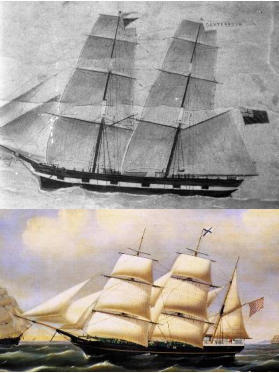
No
pictures
of
the
Rosalie
,
but
here’s
the
Cartaretta
(above) and the
Hansa
:

I
Newton Abbot and the Newfoundland trade
In
1583
Humphrey
Gilbert,
a
local
adventurer
landed
at
St.
John's
in
Newfoundland
and
claimed
the
area
as
an
English
colony.
The
fisheries
quickly
developed.
Between
1600
and
1850
there
was
a
steady
trade
between
Newton
Abbot
and
the
cod
fisheries
off
Newfoundland.
Every
year
men
from
the
town
would
gather
at
the
Dartmouth
Inn
or
Newfoundland
Inn
in
East
Street
in
the
hope
of
being
hired
for
a
season's
work.
In
the
autumn
the
dried
cod
was
stored
in
depots
and
sometimes
used
as
payment.
There
was
a
considerable
economic
spin-off
from
this
trade.
Fish
hooks,
knives,
waterproof
boots
and
rope
were
all
made
in
the
town.
The
Rope
Walk
in
East
Street
just
a
few
yards
from
the
Cider
Bar
still
exists,
together
with
the
names
Newfoundland
Way
and
St
John's
Street.
Newton
Abbot - Wikipedia
