Every now and then the newspaper archives turn up a real gem, and it’s easy to get diverted from
one’s main search. In this case I was following up the rags-to-riches story of Mary Jane Hopkins
who was rescued from her life in North Shields to live in York with a rich uncle, when I came across
such headlines as: THE FEMALE BRIDEGROOM; A LADY PLUMBER WHO DRESSED AS A MAN; A
WOMAN MARRYING A WOMAN. It wasn’t just me who was intrigued by this Chancery case,
searching further it made headlines all around the English-speaking world, from Los Angeles to
Auckland, and it had all happened in Clapham, with a marriage ceremony in Woodford in Essex.
The main player in this drama was Rachel Elizabeth Cullener; born Rachel Golding on the 11th June
1819, she had married William Henry Smith Cullener on the 28th December 1843, and they had
four children, Henry born on the 28th December 1839, Emma Louisa born on the 18th January
1842, Rachel Elizabeth born on the 18th July 1844 and William born on the 31st July 1850. Rachel
appears on the 1841 census as Rachel Golding, aged 22 living in Clapham with a one year old son
Henry Golding. (His birth was registered in the first quarter of 1840 in Newington as Henry Culliner
Golding, Emma Louisa’s birth was not obviously registered. Rachel Elizabeth’s and William’s births
were both registered in Wandsworth.)
William Henry Smith Cullener’s first wife, Rachel Young, whom he had married in 1819, died in
August 1838, apparently childlessly. WHS himself died early in 1853, and surprisingly his widow
Rachel Elizabeth had all four children baptised at Holy Trinity Church, Clapham on the 2nd
February 1853, the day his will was proved. Did she believe this would prevent her two first-born
children from being legally illegitimate?
In 1851 the Culleners were all happily at home at 4 Apsley Place, Clapham. WHS was a proprietor
of houses and a fundholder; living with them was Elizabeth Young - aged 62 she might be the
sister of his first wife, though she could also be the sister of Rachel Elizabeth’s mother, Charlotte
Young. (Perhaps all these Youngs are related anyway). WHS’s will - written in 1848 and proved on
the 2nd February 1853 - is the subject of the Chancery case that arose in the 1890s, and it is a
closely written, almost undecipherable document that must have been carefully scrutinised by all
the lawyers involved. Basically his wife was the main beneficiary as long as she remained
unmarried, when his children would inherit, and then their legitimate children. He does leave 19
guineas to his “god-daughter Caroline Newland, daughter of James Newland of Havering in the
county of Essex, Parish Clerk”.
The family has moved to 6 Union Road, Clapham by 1861, and now consists of the widowed Rachel
Elizabeth, her son William, daughter Emma Louisa and her husband Frederick Jeremiah Clarke.
Also living with them is a cousin of WHS, a certain Sophia Newland, born in Havering-atte-Bower,
and the daughter of a the village schoolmaster and parish clerk. Rachel’s son Henry had died in
1860, and Rachel Elizabeth junior is living with her [step-] aunt Elizabeth Young not far away at 10
St Andrew’s Terrace. She died in 1868, and this is the entry in the Probate Calendar:
CULLENER
Rachel
Elizabeth.
30th
January.
Letters
of
administration
of
the
Personal
estate
and
effects
of
Rachel
Elizabeth
Cullener
late
of
Campbell-villas
Eastdown
Park
Lewisham
in
the
County
of
Kent
Spinster
deceased
who
died
2
March
1868
at
1
Campbell-villas
aforesaid
were
granted
at
the
Principal
Registry
to
Rachel
Elizabeth
Stanley
(Wife
of
James
Stanley)
of
Sygnet
in
the
County
of
Oxford
the
Mother
and
only
Next
of
Kin
of
the
said
Deceased she having been first sworn. Effects under £100.
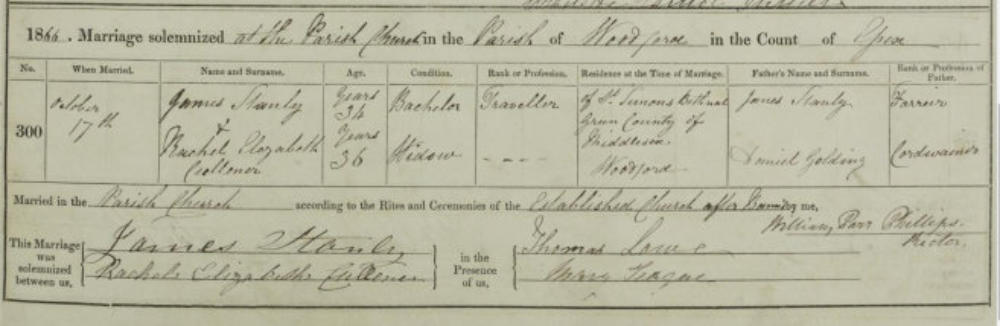
For Rachel Elizabeth senior had married again on the 17th October 1866 in Woodford in Essex; her
new husband was James Stanly, a bachelor aged 34, and a Traveller of St Simon’s Bethnal Green,
County of Middlesex, whose father, also James Stanly, was a Farrier. This entry in the marriage
register was also to be very closely scrutinised in that Chancery case in the 1890s.
Despite her husband having left her comfortably off, by the late 1850s Rachel Elizabeth senior was
in some financial trouble. The main cause of this seems to have been her son-in-law Frederick
Jeremiah Clarke, a timber merchant, and as one of the Australian papers put it: “in an evil hour Mrs
Cullener was induced to become security for him. He failed to meet his liabilities; the creditors turned to
her: and the widow was threatened with ruin”. In 1859 she had appeared at the Court for Relief of
Insolvent Debtors, and at the beginning of 1867 as Rachel Elizabeth Stanly she is in the Debtor’s
Prison.
Rachel had some novel ideas on how to get those creditors off her back.
It
occurred
to
her
that
she
would
be
able
to
elude
pursuit
of
the
creditors
by
passing
as
a
man,
and
she
also
considered
that
she
would
be
better
able
to
earn
her
livelihood
in
that
character.
She
accordingly
about
1865,
first
assumed
male
attire,
[...]
and
she
had
habitually
worn
the
same
up
to
the
present
time,
passing
under
the
name
of
Henry
Neville
Smith,
and
carrying
on
the
business
of
a
plumber
and
paperhanger
under
that
name.
(From a report on the trial in the Yorkshire Evening Post of 2nd December 1893)
It was apparently her daughter Rachel who suggested she get married in order to move her
remaining resources onto her children, and thus further confound the creditors. Her children
would be collecting rents etc. and divvying up the proceeds so she had an income. Although she is
named in several legal documents as Rachel Elizabeth Stanly (and where is Sygnet in Oxfordshire?)
she doesn’t appear thus in any census; but with the benefit of hindsight - and that case in
Chancery - she can be found, in the 1871 and 1881 censuses as Henry Neville Smith, house
decorator and paper hanger, living first in Deptford and then in Bermondsey, and accompanied by
her wife Sophia!
The Chancery case begun in 1891 (in re Cullener deceased (Clarke v. Stanly)) hinged on the validity
of her marriage in 1866, the rights of the beneficiaries of WHS’s will from 1853, and also the
legitimacy of some of her daughter Emma Louisa’s children. For it turned out now that Rachel
Elizabeth was claiming that the marriage had been a sham, that she had played the part of the
groom and Sophia Newland had taken her part as bride - they had already been living together as
Mr & Mrs Smith for over a year. The judge refused to believe this as he had a bit of paper - the
marriage certificate naming James Stanly as the groom - that said it was a valid marriage.
Unfortunately the vicar who performed the ceremony, and the two witnesses, both parish officers,
were all now dead. The signatures were carefully scrutinised and declared genuine, though the
two women claimed to have practised them beforehand. Looking at the entry in the register with
more cynical eyes, to me it does look suspicious. The groom, a traveller and declared a random
passer-by by the judge, can sign his name, and there is far too much detail given in his present
residence.
Click to enlarge
“Dressed in ordinary widow’s clothes, she gave her evidence in a masculine voice” as the papers
were quick to comment. Rachel Elizabeth Cullener used her original name (thereby surely
disputing the Stanly marriage?) and gender, during the Chancery hearings. But what never
appears to be explained is why Rachel now chooses to declare, under oath, that her marriage to
James Stanly was a sham, when she didn’t need to, though this would of course be denying her
children their inheritance, as she was strictly speaking still the widow of WHS.
Anyway Rachel and Sophia continued to live together as husband and wife, and stayed together
until about 1885, when apparently as business declined and money became short, they separated.
In 1891 Henry Neville Smith, now a “widower”, but still a paperhanger, is living at 31A Queens
Road, Peckham, with “cousins” Rachel Agnes and Henry Cullener, the children of Rachel’s son
William from his first marriage. Rachel - as Neville Henry Smith - appears at this address on the
1892 Peckham voters list. Sophia in 1891 is back home in Havering-atte-Bower, single with the
surname Newland and “living on means”, in 1901, aged 72 and single, she is an inmate in the
Romford Union Workhouse and Infirmary, aka Oldchurch Hospital. She died there the following
year. Now I don’t know what Rachel and Sophia’s relationship actually was, but the judge hinted at
his disapproval when he referred to Sophia as Rachel’s “creature”.
Rachel, who was born in 1819, is rather cavalier with her age after WHS’s death. She says she’s 36
on her marriage to James Stanly in 1866; she’s 46 in 1871, 47 in 1881 and 51 in 1891. Her death
was registered In the Camberwell district in 1898 with the name Rachel Elizabeth Cullener, when
her age is given more or less correctly as 77.
The other part of the case concerned the legitimacy of Emma Louisa Clarke’s seven children*,
particularly those four born after the disappearance of her husband, the bankrupted Frederick
Jeremiah Clarke, and was brought against her mother by Emma Louisa’s oldest daughter Rachel
Elizabeth Molz (née Clarke). Obviously worried about her own inheritance, she even gave evidence
of having caught her mother in flagrante with another man. The judge ruled however that there
was not sufficient evidence of Frederick’s absolute disappearance, that he could easily have had
“access”, and that, for all the law knew, the other children were as much his as the eldest daughter.
Perhaps it says something that Emma had her two youngest children baptised on the 30th January
1889 at St Mary’s Walthamstow, when they were 14 and 9 years old respectively, citing Frederick
Clarke as their father.
*The fact that Emma Louisa was legally illegitimate herself was never brought up, WHS’s son
William Cullener was the only surviving legal beneficiary and trustee of his father’s estate (though
as the will was written in 1848, two years before he was born, he isn’t mentioned in it). William
appears to have kept a rather low profile during these proceedings, and his own personal
relationships seem somewhat clouded! However the family must have known all of this, even my
own family who had nothing to inherit, remembered that my grandfather had been born before
his parents’ marriage and could not benefit from any (imagined) inheritance; “poor old uncle
Frank”.

Tales around the tree
Culleners, Chancery and cross-dressing - “a plot worthy of a dime novel” (Los
Angeles Herald, 21 May 1894)





Click to enlarge
Lincolnshire Echo 16 December
1893
