While looking into the Dockyard Ancells I came across a William Cortney (Courtney) who was building
ships for the Royal Navy and others in Chester in the early 1800s. My hopes that he was related to my
Cheshire Courtneys were soon dashed however.
The following lengthy quote from Herbert Hughes’ book, Chronicle of Chester: the 200 years, 1775/1975,
published by Macdonald and Jane’s in 1975, sets the scene and is an essential read for anyone
interested in the history of the town as seen through the pages of the local newspaper.
“As the years go by it is clear from the newspaper and other records that the trade of the Port of
Chester is drifting desultorily but inexorably into the silting sand. But if the bigger ships of the day can
no longer reach her, the history of former times repeating itself, the old Port can at least build ships
for others. And so, from the pen of J. H. Hanshall, second Editor of the Chronicle, we have a
contemporary picture of the Crane boat-yards about 1816. ‘Beyond the Watergate are Crane-street,
Back Crane-street, and Paradise Row, the whole of which lead to the wharfs on the river. For a
number of years Chester has carried on a considerable business in shipbuilding. Within the last ten
years the trade has wonderfully increased, and even now it is not unusual to see ten or a dozen
vessels on the stocks at a time. In fact, there are nearly as many ships built in Chester as in Liverpool,
and the former have always a decided preference from the merchants. Indeed, Chester lies
particularly convenient for the trade, as by the approximation of the Dee, timber is every season
floated down from the almost exhaustless woods of Wales, at a trifling expense and without the least
risk. The principal shipwright in Chester is Mr. Cortney, but Mr. Troughton’s is the oldest
establishment. There were lately nearly 250 hands employed in the business, two-thirds of whom
were in Mr. Cortney's yard, but the trade is at present flat. Six vessels of war have been built by him,
and within the last two years (1814-15) two corvettes and two sloops of war, The Cyrus, The Mersey,
The Eden, and The Levant, from twenty to thirty guns each. The firm of Mulvey and Co., formerly of
Frodsham, have established a yard near the Crane.’ Cortney's yard launched a brig in 1804, an East
lndiaman of 580 tons in 1810, and in 1813 a West India-man of 800 tons, in addition to the corvettes
and war sloops mentioned by Hanshall.”
Between 1814 and 1826 as many as 133 vessels were built and registered at Chester, with an average
size of 126 tons. Only one shipyard was in operation by 1831, and although it built some large vessels
the staple product from 1820 to 1850 was Mersey flats.
The London Gazette is useful for investigating business relationships or their breakdown. In the
earliest mention of William Cortney he is in Pwllheli, terminating a partnership “as Ship-Builders,
under the Stile or Firm of John Sause and Company, and under the Stile or Firm of Cortney and
Company” on the 3rd March 1800. In June that year “John Sause, of Liverpool, in the County of
Lancaster, Merchant, Dealer and Chapman”, is facing bankruptcy proceedings which involve
“completing a Contract or Agreement, entered into by the said Bankrupt and William Cortney with
Richard Dilworth, for building of a Ship or Vessel for him at Pwllhly, or to the Sale of the same, as she
is now on the Stocks”. William Cortney seems to have survived and moved his business to Chester.
In November 1811 “The Partnership between us the undersigned, as Ship-Builders, at Chester, under
the Firm of Carson, Forbes, Cortney, and Co. having expired on the 30th of September last past, the
same is dissolved accordingly”; and in January 1821, just a month before his death: “Notice is hereby
given, that the Partnership heretofore subsisting between us the undersigned, William Cortney and
Samuel Newton, as Ship-Builders, in the City of Chester under the firm of William Cortney and
Company, was dissolved by mutual consent on the 1st day of January instant”.
The ups and downs of the shipbuilding industry in Chester as far as it relates to the business of
William Cortney can be tracked through references in the Cheshire Archives found by searching on
the A2A section of the National Archives. Here is recorded his leasing of land from the mayor and
citizens of Chester generally to expand his yard from 1802 to 1815, until in April 1817 he submits a
“Petition from William Cortney, shipbuilder, wishing to surrender his lease of timberyard on foreland
of Roodee because of the depressed state of his trade”.
The Archives also shed light on his dealings with the Royal Navy. In February 1804 there was
correspondence with the Navy Board regarding the cost of shipbuilding in Chester: “The sole
objection to Mr. Cortney of Chester building another gun brig for the Navy, is the cost of either
sending the rigging to Chester to rig the ship there or of towing the ship from Chester to a Naval yard
to have it fitted there”. While William Cortney a few days later pressed his case for continuing to build:
“Mr. Cortney of Chester is not interested in building just one gun brig for the Navy, because he
quoted his price on the understanding that two would be built”. He apparently got his way: “[We] are
sending a copy letter from Peter Kennion, asking for Mr. Cortney of Chester to build a second gun
brig for the Navy”. The Naval Overseer, a Mr Hawkes, reported a month later “that the Contest gun
brig being built by Mr. Cortney, will be ready to launch on 11th June”. It is easy to understand the
Navy Board’s reluctance to use the Chester yards: all six of William Cortney’s ships were towed to
Plymouth for completion; unlike the Adams’ yard on Buckler’s Hard where the ships had merely to be
towed across to Portsmouth Harbour for rigging.
At a meeting of the Committee of Ship-owners for the Port of London, held at the London Tavern, on
the 16th April, 1806, with R. Curling, Esq. in the Chair, it was resolved, "That the secretary do write to
the out-ports for an account of the ships now building there, and also in the river Thames, and
whether they are building on contract or speculation, and when they were first laid down". The
responses that follow provide a detailed look at the state of shipbuilding in the country, and among
them is a response from John Troughton at Chester:
"Chester, May 20, 1806.
Sir, I Received yours of the 13th instant, and now send you, annexed, the number of vessels, with the
tonnage, &c. that are building at this place.
I remain, Your humble Servant,
John Troughton.
Messrs. Carson, Forbes, Cortney, and Co. have four vessels building, the whole register tonnage about
1500 tons, all [...] "
Unfortunately - and frustratingly - the next two pages are missing from the GoogleBooks edition!
Called A Collection of interesting and important reports and papers on the navigation and trade of Great
Britain, Ireland, and the British colonies in the West Indies and America, with tables of tonnage and of
exports and imports. Printed by order of the Society of Ship-owners of Great Britain, 1807: it would be a
useful exercise to track down and find a complete version as it contains a lot of other information
relevant to any study of British shipping at the start of the 19th century
According to the New Monthly Magazine of 1st July 1817 “On June 10th, a fire broke out in the shipyard
of Mr Courtney, Chester, and spread with such rapidity as to occasion considerable loss before it
could be subdued.” The Lancaster Gazette for Saturday 14th June 1817 goes into greater detail: “A
dreadful fire broke out in the ship-yard of Mr. Cortney in Chester on Tuesday se'nnight. It began in the
smithy and adjacent buildings, and no exertion could prevent the flames from spreading over the
whole of the east side of the yard. The saw-pit, huts, tool-room, moulding-rooms, &c. soon presented
one great mass of fire. It was at mid-day, and in about two hours all this valuable property was
destroyed. The loss which Mr Cortney has sustained by this calamity is great: he has carried on with
high respectability one of the largest ship-building establishments in that part of England; and gave
employment to a great number of hands.”
It seems likely that the William Cortney, ship-builder, of Chester is the same William Cortney, 25,
shipwright of Skerton, and freeman of Lancaster, who married by licence Elizabeth Hall in St Mary,
Lancaster on 24th September 1793, with witnesses Rich'd Hall and Dorothy Hall. They had a son and
a daughter baptised at St Mary’s: James on the 5th June 1796 and Hannah on the 14th October 1798.
A Samuel Courtney, the son of William Courtney was buried at St Mary’s on the 4th December 1796;
the register only gives the abode as Lancaster, but he could possibly have been a son born in 1794.
William and Elizabeth had at least three daughters born in Chester: Margaret who married John
Wilson on the 23rd October 1826 at Holy Trinity in Chester, and Ann who married Liverpool Captain
Francis Stewart, on the 4th February 1828. Another possible daughter, Elizabeth, is living with her
mother and the Stewarts in Liverpool in 1841. She never married, but carried on the trade of licensed
victualler in Liverpool until her death in 1880.
William Cortney was a Lieutenant in the Chester Regiment of Volunteers in 1803, a freeman of the
City, and was elected Sheriff in October 1808. The death of a Mr. W. Cortney at Chester is reported in
the New Monthly Magazine of 1 April 1821, while the Liverpool Mercury of February 23rd 1821 more
precisely reports his death: “On Friday the 9th instant, aged 56, Mr William Cortney, one of the
members of the Corporation of Chester”. This must be the same man as he is described as “late” on
the launch of the Liverpool in June 1821, and in September 1821 the Liverpool Mercury reports from
the Chester Guardian that the late Mr Cortney's ship-building yard is to be taken over by some
Liverpool gentlemen “who intend to carry on the business there to a considerable extent”.
William Cortney, "late of the City and Diocese of Chester, Ship Builder, deceased" died intestate, and
two years after his death his widow Elizabeth as administratrix was bound over on 4th November
1823, under a penalty of £200 payable to the Bishop of Chester, to provide letters of administration
within a year. The document of administration is endorsed by hand on the reverse: "The eleventh
day of November 1823. The within named Elizabeth Cortney took the usual oath of an Administratrix
in common form, and she also made oath that the Personal Estate and Effects of the Intestate within
the Diocese of Chester were under the value of One Hundred Pounds."
The death of Elizabeth Cortney is reported in the Liverpool Mercury of Friday June 10 1842: “On
Monday last at the house of her son-in-law [Francis Stewart, living in Burlington Street, Liverpool in
1841], aged 75, Mrs Elizabeth Cortney, widow of the late Mr. William Cortney, ship-builder, Chester,
much respected.”
Next page: Details of some of the ships built by William Cortney at Chester

Tales around the tree
William Cortney, shipbuilder of Chester




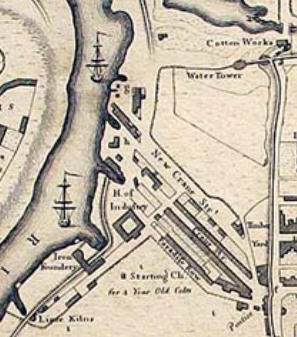
Detail of ship-yards from Stockdale's Map of
Chester 1795. The website ‘Chester: a virtual
stroll around the walls’ has an excellent
selection of old maps. Click on the image above
to go there.

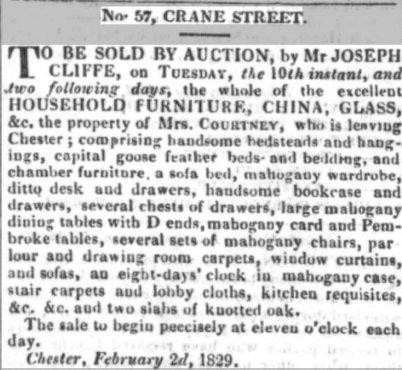
Chester Courant 03 February 1829
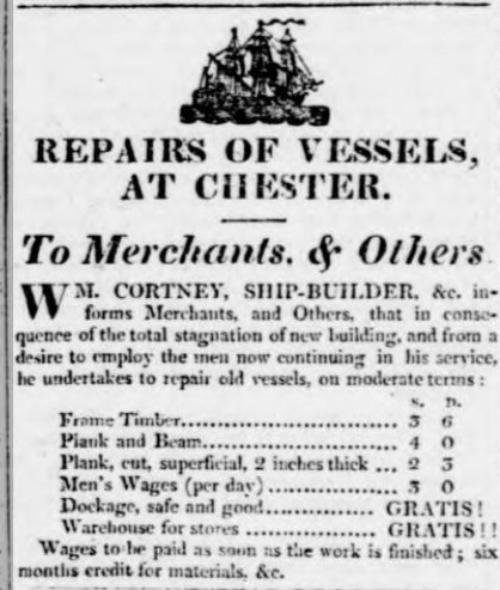
Chester Chronicle 08 November 1816
Click to enlarge
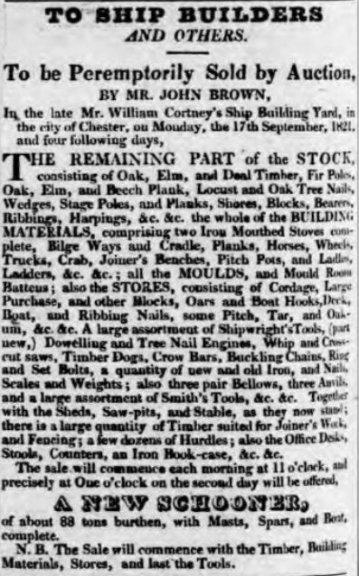
Chester Courant 11 September 1821