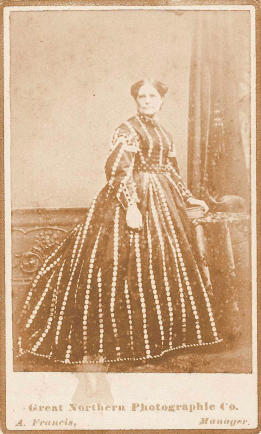
A confusing tale of two Andrew Murrays
Andrew John Murray (b. London, 1808) and Andrew Murray (b. Scotland, 1813) both went to South
Australia in 1839.
Andrew Murray was born on the 16th May 1813 in Kirkbean in Kirkcudbrightshire, Scotland and
baptised on the 21st May that year. He was the third of apparently four children born to his parents,
William Murray "Preacher of the Gospel" and his wife Mary Bridges. The Reverend William Murray not
only preached in the Church of Kirkbean but also taught in the Old School. His gravestone in Kirkbean
kirkyard reads:
"In memory of The Reverend William Murray, Teacher in Kirkbean for 51 years, who died 11th Dec.
1857 in his 78th year. [text in Latin]. Also Mary Bridges his wife, who died 11th Jan. 1852 aged 72 years.
Also John B. Murray their son who died 13th Feb. 1816 aged 9 months. Also Sarah Murray their
daughter, wife of J.A. Gilfillan, who died at Glasgow 13th Aug. 1837 aged 27."
Their other daughter Agnes Thomson Murray (born 7th August 1809) married John Gibson on the 17th
July 1829 in Kirkbean and their descendants are now living in Canada.
Andrew presumably began his education with his father before attending university in Glasgow where
in 1836 with a work on Oliver Cromwell he won the Peel Club's first prize essay.
What prompted him to go to South Australia remains unknown, but he arrived at Port Adelaide in 1839,
the same year as Andrew John Murray. Not surprisingly in the early records of the colony the two men
get confused. Andrew John Murray consistently uses his middle name, presumably a trait from
childhood to distinguish himself from his father - also called Andrew. Andrew Murray was not baptised
with a middle name; in Scotland if a middle name was given it tended anyway to be a family surname
not a second christian name.
The Australian Dictionary of National Biography records that Andrew Murray arrived in Adelaide in
January 1839, but searching the passenger lists that are available online throws up no suitable
candidate. So is it possible that he arrived in October on the Palmyra which sailed from Greenock on
the 3rd July 1839? An Andrew Murray is named in the passenger list that also includes David Spence -
who would become Adelaide's Town Clerk - and his family including two daughters, Catherine and the
Jessie who was to marry Andrew on the 2nd November 1841.
Andrew John Murray arrived in South Australia with his wife Georgiana. There is no
exact match on the passenger lists: but the most likely is with the “Murray, Mr & wife
- cabin” who arrived on the Caroline from London on the 17th December 1839.
Looking through the early records of the colony it is fairly safe to say that references
to Andrew Murray, Merchant, refer to Andrew Murray. That is how he describes
himself in his marriage announcement in The Adelaide Independent of Thursday 4th
November 1841, and when he is in gaol as an insolvent debtor at the end of 1842 the
South Australian Government Gazette refers to him as: “Andrew Murray, Merchant,
Hindley-st., and Rundle-st.” But then to confuse matters there are references to "A. J.
Murray" - merchant and postmaster in some 1841 directories.
I have so far found only one occasion when the two men appear at the same event.
On Saturday 26th August 1848, as The South Australian reported on the following
Tuesday: “On no former occasion has a Levee in South Australia been so numerously
attended as that of Sir Henry Young, on Saturday, the birth day of His Royal Highness
Prince Albert […] Murray, Andrew; Murray, Andrew John; [among many others]”
Andrew Murray formed the drapery business of Murray, Greig & Co.,which failed in
November 1842. He became editor of the South(ern) Australian early in 1843 and its
proprietor from 31 October 1844 to 19 August 1851. From 1845 he also acted as
government printer and at his office in Rundle Street issued many periodicals, the
weekly government gazette and annual South Australian almanacs and directories. In
January 1852 he founded the conservative Adelaide Morning Chronicle but sold it in
May 1853. In 1852 he moved to Melbourne where he joined the Argus as its
commercial editor and political writer, and further references to Andrew [John]
Murray in Adelaide and Port Lincoln can only refer to the one man.
Andrew John Murray worked in numerous government posts from October 1840 to
June 1860, including Town Clerk (pro tem.), Collector of Rates, Clerk of the Market,
Assistant Commissioner of the Gold Fields, Superintendent of Convicts, Registrar,
Justice of the Peace and Stipendiary Magistrate, and Government Resident in Port
Lincoln. He bought land, built two houses, one at Athelstone, and the other,
Ravendale House in Port Lincoln. He wrote letters to the papers, squabbled with his
neighbours and generally seems to have rubbed people up the wrong way with his –
apparently – pompous manners and opinions. Having failed to get elected to
Parliament in 1865, he returned to England at the beginning of 1866, following his wife on the City of
Adelaide – she had also sailed on that ship, one year earlier, to return home to administer the estate of
her mother. Once home he continued in a semi-public life, writing more letters to the papers and
remaining litigious. Declared bankrupt in 1879 – probably as a result of a business dispute with his
brother - he died in 1880 just eleven days after having his bankruptcy annulled.
… and a third
I confirmed a lot of my assumptions about Andrew John Murray while in email correspondence with a
gentleman in Adelaide by the name of Gus. I first came across him when he wrote to his local paper on
the origins of the name Athelstone. He had traced it back to a shepherd called Andrew Murray who had
arrived in the colony in 1839 from the Scottish borders. There were a number of problems around this,
the main one being that a shepherd would probably not have been able to afford the £300 needed to
purchase the original plot of land. Gus did a lot of research locally for me – for which I am eternally
grateful – and eventually by comparing the signature on Andrew John Murray's marriage licence
application with those on Adelaide documents, he had to admit that he'd been wrong. As he had based
his derivation of the name Athelstone on placenames around Andrew the shepherd's Peebles, we were
no nearer to finding out why Andrew John Murray called his first house Athelstone.
The shepherd Andrew Murray appears to have arrived in Adelaide with his wife Marion (née Ballantyne)
on the Prince George on the 26th December 1838. Both aged 23 they came from Eshiels Hope near
Peebles, and had been married there in August that year before sailing from London on the 12th
September. They don't appear on the 1841 South Australian census, as they had already moved on to
Melbourne where they had a daughter Marion baptised on the 2nd February 1840, and another
daughter Margaret on the 14th October 1843. (FamilySearch) Following them up in the Australian
newspapers, Andrew adopts the middle name John, and becomes a painter. They had another
daughter, Agnes, who married William Lush in 1880; a son Andrew who married Adah Russell in 1901;
and a daughter Sarah who died in 1861. When their daughter Margaret was married to George Twiss in
1868 she is described as “the third daughter of Andrew John Murray, formerly of Peebles, Scotland”.
Andrew and Marion's deaths are also announced in The Argus. This Andrew John Murray died, aged 72
years and 10 months, on the 18th May 1889, and he is described as a Victorian colonist of 50 years.
Marion died on the 29th July 1900, aged 84; she is a Victorian colonist of 61 years. That puts their arrival
in 1839, and their births in 1816/1817, which tallies quite nicely with the passenger details on the Prince
George.
Georgiana Hayward aka Mrs A.J. Murray
Georgiana Hayward was born on the 18th January 1817 in
Princes Street, Rotherhithe to George Hayward, a Clerk in the
Bank of England, and his wife Sarah. George Hayward had
married Sarah Winnock on the 21st October 1806 at Lexden in
Essex, where she lived with her recently widowed mother. Her
father, Samuel Winnock, was a descendant of John Winnock,
baymaker of Colchester. Her sister Mary Ann Winnock probably
moved to Rotherhithe to be with her after their mother’s death
in 1810, for she married James Payne, another Bank of England
employee, there on the 6th August 1812.
George and Sarah had five children baptised in Rotherhithe:
George Winnock Hayward and Samuel Fisher Hayward in 1811;
Sarah Ann in 1812 and Harriet in 1815; Georgiana was baptised
on the 26th February 1817. By 1837 when Georgiana married
Andrew John Murray, her mother was a widow and she was the
only surviving child.
George Winnock Hayward died before 1832, the year both his
brother Samuel Fisher Hayward and their father George died.
George’s death was reported thus in the Essex Standard of
Saturday 14 April 1832:
8th inst. at Walton-le-Soken, Mr. George Hayward, aged 48, late of the Bank of England. The affliction
which terminated his life, although severe and protracted, was borne with great patience and
equanimity of temper. His urbanity of manners, and his moral and social values, endeared him
through life to all who had the pleasure of his acquaintance. Scarcely two months since he was
bereaved of his only son, an amiable young man of 22 years of age.
George had re-written his will shortly before his death - probably as a result of his son’s death - and he
describes himself as “of Judd Street, Brunswick Square, London but now residing at Walton in Essex.”
Judd Street must have been the family home at this time as it was also the address given on the burial
register of St George The Martyr, Queen Square in Camden for Samuel Fisher Hayward. Were there
family connections to Walton or was he staying in some kind of convalescent home? In his will he leaves
everything to his wife and daughters; however Sarah Ann was to die in 1835, being buried in the same
place as her brother Samuel Fisher, and I have found no further trace of Harriet after her baptism.
The Murrays at this time were living in Hunter Street, which as the southern continuation of Judd Street
would have made them fairly close neighbours of the Haywards. Did the young Andrew John Murray,
training as a solicitor, admire the even younger Georgiana, before her move to south London where her
mother went probably to be nearer her sister Mary Ann Payne?
Andrew John Murray applied for a marriage licence on the 23rd of February 1837: “Appeared personally
Andrew John Murray of the Parish of St Pancras in Middlesex, a Bachelor, aged twenty one years and upwards
and prayed a Licence for the Solemnization of Matrimony in the Parish Church of Saint Mary, Newington in
the county of Surrey, between him and Georgiana Hayward of the Parish of Saint Mary, Newington aforesaid,
Spinster, a minor aged twenty years and upwards. [...] And he further made Oath that She, the said Georgiana
Hayward, hath had her usual place of abode within the said parish of Saint Mary Newington for the space of
fifteen days last past. And he lastly made oath that the consent of Sarah Hayward, Widow, the natural and
lawful mother of the said minor, her father being dead and she having no Testamentary or other Guardian of
her person lawfully appointed, having been obtained to such marriage. [Signed] AJ Murray.”
The wedding took place on the 2nd March 1837, by licence, but not at St Mary, Newington, instead at St
George, Camberwell. “Andrew John Murray of the parish of St Pancras, Middlesex, a Bachelor & Georgiana
Hayward of this parish, Spinster & minor were married in this Church by Licence with consent of Sarah
Hayward, widow, the natural and lawful mother of the said minor this second day of March one thousand
eight hundred and thirty seven, by me Samuel Smith. [Signed] Andrew John Murray, Georgiana Hayward, in
the presence of [signed] James Payne, Margaret Murray, MAH Cotton.”
Perhaps Georgiana’s mother regretted losing her only surviving daughter to a husband, but accepted it
as a necessary step in life. I wonder if she was so accepting of the next event in her daughter’s life:
when on the 28th June 1839, with her husband, she sailed on the Caroline for Adelaide in South
Australia where he was to take up a series of posts with the Government.
Once in Adelaide, while her husband was pursuing his career in the Government service, Georgiana
had a musical career of her own as a pianist, piano teacher and composer and a South Australian
directory for 1851 has the following:
A.S. Murray [sic], Clerk of the Cattle Market, Thebarton.
Mrs Murray, Professor of Music, Thebarton.
Among her pupils was the young pianist and violinist Richard Baxter White. At least two published
compositions by her are documented as new in 1860, both to words by Boyle Travers Finnis, and both
lost: The Gathering (“A War Song of Australia; words by B. T. Finniss, Esq., M.P., music by Mrs. A. J.
Murray, Adelaide Glee Club”), and Canst thou not read the mute appeal (song; “the words by B. T.
Finniss, and the music by Mrs. Murray”).
A stalwart and possible founder member of the Adelaide Choral Society, Mrs Murray performed in
many concerts as a soloist - both vocal and on the piano - and accompanist. Indeed the South Australian
Register on Wednesday 14 November 1849 commented thus on her contribution to the musical life of
the town:
We are glad to find that the committee of the Mechanics' Institution have exhibited their appreciation
of the invaluable services of that sweet vocalist and accomplished pianist, Mrs Murray, by electing her
an Honorary Member. They have likewise, at their meeting of last evening, passed the following
resolution : — 'That the Committee feel bound to express to Mrs Murray the grateful sense they
entertain of her past exertions in aid of the Institution, and the gratification which the exercise of Mrs
Murray's distinguished musical talents at the conversaziones of the Society have so repeatedly afforded
to themselves and every member of the Institution'. Mrs Murray, by affording the gratuitous aid of her
inestimable musical talents to this Society during the two years which have elapsed since its revival, has
been the main instrument in working out its present degree of prosperity, for it is a lamentable fact that
neither lectures, discussions, nor Library have afforded sufficient attraction to members to induce them
to keep their subscriptions from getting into arrear, and that the majority of the members have
neglected to renew their quarterly tickets until the eve of the musical entertainments, which they have
oddly enough designated conversaziones.
As a sideline she also apparently took to silk production when she exhibited at the Great Exhibition in
London in 1851, “a specimen of silk raised by her at Adelaide in 1850, the produce of 580 worms, fed on
white and black mulberry leaves”. The South Australian Register also reported in February 1853 that they
had seen the “Exhibition certificate forwarded to Mrs Murray, and the certificates and medals obtained
by a brother of Mr Murray’s”. This is Andrew John Murray’s youngest brother, William, who had arrived
in Adelaide in January 1853 with his family to work as a civil engineer and surveyor.
When her husband took up the post of Government Resident in Port Lincoln, Georgiana took over the
running of the church choir there.
Testimonial to Mrs. A. J. Murray, Port Lincoln.— On the 5th instant a deputation from the congregation
of St. Thomas's Church and the residents of Port Lincoln waited upon Mrs. A.J. Murray to present the
following testimonial to her upon her departure for England:— "The congregation of St. Thomas's
Church with others resident in Port Lincoln are very desirous of testifying their high sense of the
services which have been rendered during many years past by Mrs. A.J. Murray in conducting the
choral portion of the services in that church. The kindness and zeal which that lady has at all times
shown they wish to acknowledge with every feeling of gratitude, and think that they cannot seize a
more favourable opportunity for so doing than on the eve of her departure for England, or a better
mode of evincing their sentiments on this subject than by requesting Mrs. Murray's acceptance of the
accompanying purse, which, although confessedly an inadequate expression of their feelings, they
request her to make use of in any mode which may seem most agreeable to herself." The purse, which
was of a very handsome description, contained 60 sovereigns, which Mrs. Murray signified her
intention of laying out when in England in a manner best calculated to perpetuate the remembrance of
so gratifying a demonstration of friendship and esteem.
South Australian Register Thursday 12 January 1865
Georgiana sailed away from South Australia in the City of Adelaide on the 20th January 1865 and arrived
back in London on the 3rd May, three and a half months after her mother’s death on the 16th January.
Perhaps she had hoped to see her again before she died; letters would have told her that she was
failing, though hardly surprising in a lady of her advanced years:
Jan. 16th at 181 Albany Road, Camberwell, aged 86, after a long illness, Sarah, relict of George
Hayward, late of the Bank of England, and youngest daughter of the late Samuel Winnock of Great
Horkesley, in this county.
Essex Standard Wednesday 25 January 1865
Her mother’s will, written in 1860 at 240 Albany Road was proved on the 24th February 1865. She leaves
all her household furniture, clothes, jewellery, plate and linen to her brother-in-law Mr James Payne and
her sister Mary Ann Payne, and she gives all the remaining property to her only daughter Georgiana
Murray the wife of Andrew John Murray of Port Lincoln in South Australia. Andrew John Murray arrived
back in England on the 13th April 1866, and in the 1871 census they are living at 181 Albany Road with
Georgiana’s widowed aunt, Mary Ann Payne, and he describes his occupation as Special Magistrate
South Australia.
Mary Ann Payne died on the 17th November 1873, and her will is a study in the connections and
interests of a widowed and childless middle-class lady. After a lot of small and some not-so-small
bequests she leaves her leasehold houses in Albany Rd.,123, 179, 181 and the rest of her property to
her niece Georgiana Murray, daughter of her late sister Sarah Hayward, and appoints Andrew John
Murray formerly of Australia and Georgiana Murray executor and executrix.
On the 19th October 1874 Andrew John Murray wrote his will at Athol House, Knatchbull Road,
Camberwell - a name that has echoes of the house he called Athelstone in Adelaide. By 1879 during the
course of his bankruptcy proceedings his address is Ravendale, Macaulay-road, Clapham - a name
identical to his house in Port Lincoln - and that is where he died on the 27th October 1880.
In 1881 Georgiana is living at 57 The Chase, Clapham, and in 1891 she is at 175 Upland Rd, Camberwell
where she died on the 22nd March 1901.

The Murrays
Andrew John Murray & Georgiana Murray (née Hayward)