My first cousin three times removed was born on 9th November 1861 at 13 Northwick Terrace, St John,
Marylebone to William Murray, civil engineer and his wife Elizabeth née De Normanville. His birth was
announced in The Times of November 12th 1861, and his mother’s death was announced nine days later.
Elizabeth was buried in Kensal Green cemetery and on January 31st 1862 William signed the remaining plots
over to his brother Charles Henry Murray.
London Evening Standard 22 January 1862
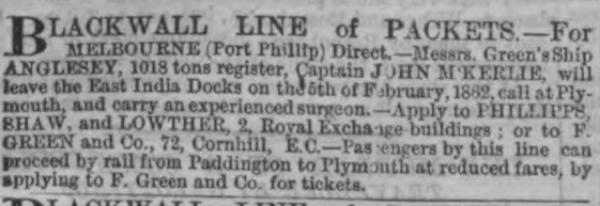
Five days later William embarked on the Anglesey in London (it sailed via Plymouth) with his five sons to return to
Australia, where he had previously established a business as a civil engineer in Adelaide. Travelling with them as
cabin passengers are two nurses, Mrs and Miss Schmidt, hardly surprising as Andrew was only 3 months old,
Edward was 3, Louis 5, Harry 7, and William Charles 13. William probably needed all the help he could get.
Hereford Times 4 December 1861. William obviously decided quickly to return to Australia.
The Anglesey arrived in Melbourne on the 23rd of May 1862, and on the 4th of June the family sailed on the SS
Havilah for Adelaide, arriving on the 8th. Andrew was baptised on the 7th December 1862 at St. Thomas’s church
in Port Lincoln, where William’s brother, Andrew John Murray was Government Resident, and his wife Georgiana
organised the church’s music.
Once back in Adelaide William resumed his career and on the 7th July 1863 he married for the second time,
again at St. Thomas’s in Port Lincoln. With his new wife he had a further four children, three of whom survived
into adulthood. The youngest child was only three years old when William died on the 22nd August 1875, and
Andrew, then aged 13, had to appear as a witness at the inquest as he was the last person to see his father alive,
and when returning with a doctor, had found him dead. He testified as to his father’s poor state of health and
also to his use of morphia and alcohol; the coroner’s verdict was that William’s death was from “natural causes,
accelerated by intemperate habits”.
One can only speculate on the effect this had on the young Andrew; his older brothers had all probably left
home, and his step-mother who was too poorly to attend the inquest had her hands full with the younger
children. So it is not really a surprise when he turns up in England, and just over two years later enlists in the
Royal Navy.
William had always been close to his older brother Charles Henry Murray. In the early 1850s they had been
neighbours in Newington in south London, and had shared family celebrations and tragedies until William went
to Adelaide. In 1861 Charles Henry had taken over the burial plots at Kensal Green from William, so it seems
more than likely that they corresponded when apart. Andrew John Murray with his wife Georgiana had also
returned to England from Adelaide in 1865, so here was another London contact for the young Andrew.
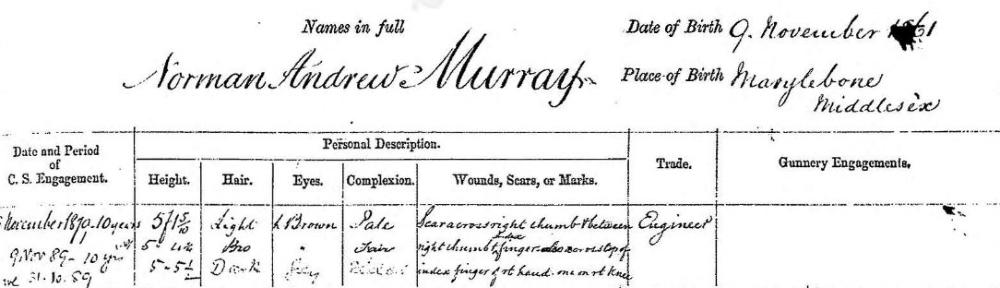
Andrew Hodges de Normanville Murray changed his name for the purposes of the Royal Navy: he became
Norman Andrew Murray, or more usually just Norman Murray. His service record appears on Ancestry, and it
begins on the 18th January 1878 when he is Boy 2nd Class on HMS Fisgard; a week later he is moved to HMS
Boscawen, and in January 1879 on the same ship he is made Boy 1st Class. Moving to HMS Agincourt he is an
Ordinary Seaman by December that year, and that is the ship he can be found on in the 1881 census.
Click to enlarge
He progresses to Able Seaman in September 1881 on HMS Royal Adelaide, a ship he would serve on several times,
along with HMS Valiant, HMS Leander (July 1885 - April 1889) and HMS Banterer. His character is usually described
as Exemplary or Very Good, although he spent three days in the cells in 1880 for an unspecified misdemeanour.
By November 1889 he had completed his ten years, but he continued in the service. By 1891 his health was
beginning to fail; he had been promoted to Corporal in April that year on HMS Wildfire, and that must have been
when he wrote his will. He appears twice on the 1891 census, once at 5 Beach Street, Minster-in-Sheppey, and
again on the list of persons not on board HMS Pembroke, where his name is crossed out, and annotated “Sick,
and Discharged to Wildfire”. He was officially invalided out of the Navy from HMS Vivid I, on the 4th March 1892 to
hospital, and traced for his pension on 21st March.
The details of his will as given in the National Probate Calendar confirm his name change and also his family
links, though rather obliquely, with Charles Henry Murray:
MURRAY Norman otherwise Andrew Hodges de Normanville of 126 St. George's-avenue Islington Middlesex
retired ships' corporal Royal Navy died 19 November 1892 at sea Probate London 5 August to Alice
Matilda Disney spinster Effects £35 9s 6d.
In the 1891 census 126 St. George's-avenue is the address of John Bryce and his wife Alice (née Milleman). He is
the brother of Charles Henry’s son-in-law, George Bryce, and she is the niece of Charles Henry’s late wife
Caroline Augusta Milleman. Alice Matilda Disney (a possible romantic connection? She was the same age as him,
and died unmarried in 1926), was the sister of Alfred Norman Disney, headmaster of Islington School, who was
one of the executors of Charles Henry’s will. The Murrays and the Disneys appear to have known each other
from their days living on and around Blackheath Hill.
Charles Henry Murray died on the 2nd December 1891, thereby severing the last of Andrew’s close links with
England, though his uncle did leave him £50 in his will, which he had written at the beginning of 1888. Knowing
he was ill, Andrew probably spent some of this small inheritance on a ticket to return to Australia. As Norman
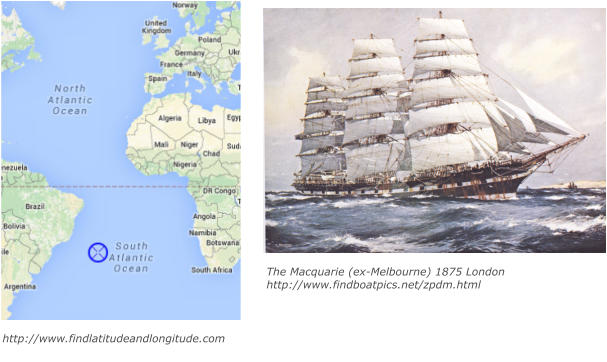
Murray he embarked at Gravesend on the Macquarie sailing on the 5th October 1892, he was never to reach his
destination.
Whether he was naturally reticent, or more likely, too ill to communicate with anyone on board, when his death
from phthisis was registered on the 19th November 1892 in Lat 27S Long 29W most of his details such as
occupation and last place of abode are unknown. His nationality is given as “Scotch” on the Macquarie’s
passenger list - somewhat surprisingly - and this meant that his death at sea was communicated to the Registrar
General’s office in Scotland, and the record can be found on ScotlandsPeople.
If Andrew had died in England he could have been buried with his mother in Kensal Green cemetery, instead his
resting place is in the South Atlantic.

The Murrays
On the trail of Andrew Hodges de Normanville Murray