It’s one of those 99% things, but I have decided that William Skinner the shoemaker of Stratford
is most likely the brother of my greatx2 grandfather John Skinner (who sadly died before 1841)
on the following grounds:
•
William had a brother John born in 1806, the same year my great great grandfather John
was born
•
They both married in the parish church in Leyton in Essex
•
They both lived and worked in Stratford in Essex
•
They both had the occupation of cordwainer or shoemaker
•
John’s son Henry was sent to Witham where William was born, after the death of his father
•
Someone, most likely their uncle William, provided the training in shoemaking that allowed
John’s sons John and Henry to continue the family trade
So I thought I would spend some time looking into William Skinner, for lack of any information
on his brother, John. Surprisingly the paper (or online) trail goes back to Maldon in Essex, for
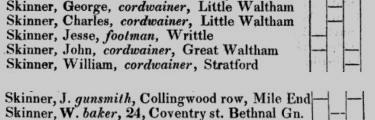
William appears on The Poll for Members of Parliament, for the Borough of Maldon 1826.
Maldon was unusual: “because of the unique nature of the Borough's historic rights many men
living in or connected to Maldon gained the right to vote. The system, however, was open to
abuse and corruption. Entitlement to vote was either by residence or as freemen. The right of
freemen was by birth or apprenticeship, and daughters of freemen could give right to their
husbands. The right of freeman could also be purchased or made honorary, and many freemen
did not live within the Borough's boundaries”. [History House]
All the Skinners listed are related: John Skinner of Great Waltham is William’s father, Charles,
W[illiam] and J[ames] are William’s uncles, his father’s brothers, while George and Jesse are
William’s first cousins once removed (though George could possibly be an uncle). The common
link between Witham, Maldon and the cordwainers is Martin Skinner, who was born in Witham
and was working as a cordwainer in Hatfield Peverel by 1699. He subsequently moved to Maldon
with his family, and his son Martin perhaps provided the apprenticeships for the other Witham
Skinners who moved away from the cloth trade. The earliest Martin Skinner, who died in Witham
in 1697, was a card maker, however I haven’t yet been able to link him with the descendants of
John Skinner, though as his descendants probably gave my Witham Skinners their voting rights
in Maldon, there could be a familial as well as an occupational link: after all, they are not all
cordwainers …
William Skinner was born in Witham on the 6th April 1800 to parents John Skinner and Mary
Davies. He followed his father’s trade of shoemaker and moved south through Essex towards
London, where he married Harriot Elizabeth Hall at St Mary’s in Leyton, Essex on the 6th
February 1825. He set up his successful business in Stratford in Essex where their eight children,
five of whom survived into adulthood, were born. The three boys, George Henry William (b.
1826), William (b. 1828) and Henry (b. 1833), all emigrated to the United States and ended their
days in New Orleans. His daughters, Emily Ann (b. 1838) and Adeline (b. 1841), both married in
West Ham, and had families of their own.
William Skinner made it into the Essex newspapers twice. The first time was in August 1833 when
his premises were broken into and two pairs of boots and twelve pairs of shoes were stolen (the
newspaper reports vary on the precise number). The two burglars fled the scene leaving behind
a trail of footwear and one of them was soon discovered hiding in the traditional nearby privy.
Samuel Murrell and Allen Lane both subsequently appeared at the Essex Quarter Sessions and
were sentenced to death, though as a result of successful petitions this sentence was commuted
into seven years transportation. The list of the petitioners in both cases is headed and signed
personally, by William Skinner, prosecutor. The petitions also give an insight into the
backgrounds of the guilty parties. Samuel Murrell has a wife who is pregnant, and three children,
and also “aged and industrious” parents. Allen Lane has a mother “of the advanced age of sixty
and almost blind” whom he presumably supports in his occupation as a painter. Although his
mother declares this to be his first offence, it seems likely that he is the Allen Lane sentenced to
three months imprisonment for Larceny at the Westminster March Session in 1831.
Further petitions, while the two were awaiting transportation on board the convict ship Justitia,
failed to allow them to serve their term in England, and Samuel Murrell was transported to New
South Wales on the 12th March 1835. I haven’t been able to find out what happened to the
family he left behind, but he seems to appear later in Sydney married to a Martha, and with
children. Their circumstances seem dire, with the children dirty and impoverished, and Martha
well-known to the local bench for an overindulgence in alcohol, as is reported during the 1850s
in the local Sydney press. What happened to them after this time I can’t discover; but he is not
the Samuel Murrell who died in Parramatta in 1879, and who was survived by his wife Caroline:
this one was born in Rochford in Essex in 1806 and married Joanna Caroline Gyunt (this is clearly
what was written in the parish register, though as she can’t sign, we must assume this is what
her unusual surname sounded like) there in 1830. They sailed voluntarily to Australia on the
Duchess of Northumberland in 1838, and don’t appear to have had any children.
Allen Lane stayed on board Justitia from 14th January 1834 to the 23rd May 1838, when he was
pardoned. I can’t find him in any subsequent censuses, so perhaps he just disappeared back into
the London underworld.
William Skinner’s second appearance in the press was in 1844, when as the result of a
presumably freak accident he lost a lot of money.
£385 IN BANK OF ENGLAND NOTES DESTROYED BY FIRE. - On Monday evening Mr.
W. Skinner, a boot and shoe maker, carrying on rather an extensive business in
High Street, Stratford, went with a £20 note into his cellar, for the purpose of
depositing it with several others (which it appears he kept in a tin kettle), to the
amount of £380; when in the act of depositing the £20 note in question some
person entered his shop, and he left the cellar for the purpose of ascertaining what
was wanted, and on his return, he found the whole of the notes, amounting to
£400 in flames, and he only succeeded in saving £15. It is supposed the notes were
ignited by a spark falling from the candle. Unfortunately the numbers are not
known; therefore there is no probability of any portion of the money being
recovered from the Bank of England.
Essex Standard 14 June 1844.
According to the National Archives currency converter, which has not been updated since 2005,
£400 is the equivalent of over £17,000 today. This calamity, while indicating the success of his
business, suggests he had a distrust of banks and a rather careless approach to money in
general. When William died in 1864, the entry for his will in the National Probate Calendar states
that his effects are “under £600”. So perhaps he never did make up his loss from this strange fire.

Bradley families: the Skinners
William Skinner (1800-1864) Stratford shoemaker